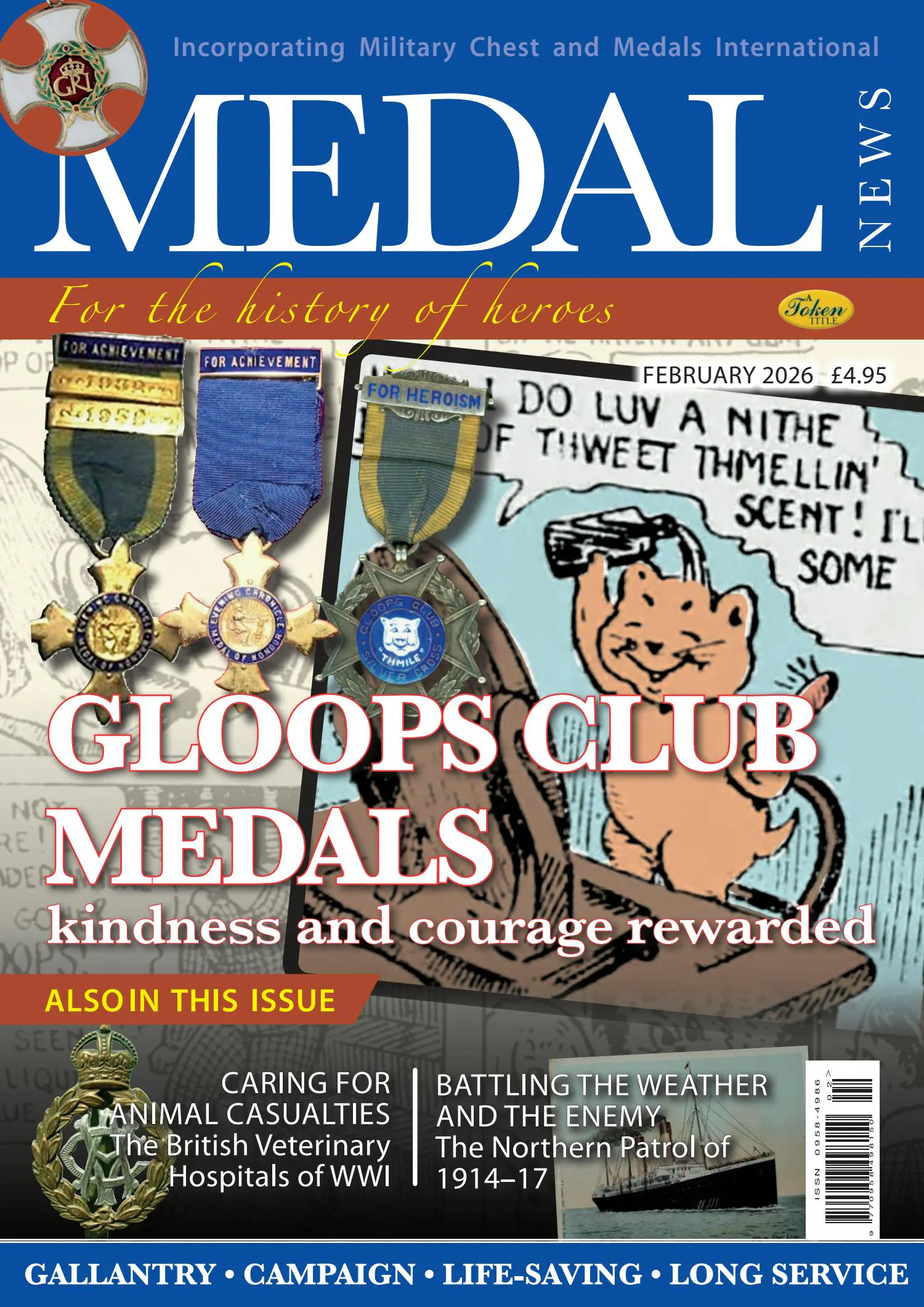
Gloops Club Medals
Volume 64, Number 2, February 2026
A pricing predicament BACK in November’s Editorial Comment, I spoke of the ever-increasing price of precious metals, in particular silver, and asked whether or not that would lead to the scrapping of some medals as we last saw in the late 1970s. This month’s “News & Views” shows that yes, we are indeed seeing that, even when the value of the medal as a collectable outweighs its silver value. Since I wrote that piece in late October 2025, all precious metals have continued on an upward trajectory and today, on January 23, 2026, silver stands at a staggering £73.59p a troy ounce, and there’s no immediate signs of it dropping; therefore, we must assume that we are, indeed, about to witness another bleak period where medals begin to disappear into the melting pot to be lost forever. Before this spike, a British War Medal (BWM) was worth £15–20; this was because the amount of silver it contained wasn’t worth more than its value as a historical item—a BWM was priced purely as a collectable. Today, with the price of silver as it is, that is no longer the case. Yes, a War Medal is .925 sterling silver and not the .999 fine silver that the markets are quoted in, but that simply means its 92.5 per cent pure, so you just have to multiply the silver spot price by 92.5 per cent, or divide by 100 and multiply by 92.5—which ever you find easier. That means a single British War Medal and its suspender (which is 80 per cent pure) is worth somewhere in the region of £67–68 as an item of scrap. Logically, that would indicate that your average World War I pair should be worth around £80 if you assume £10–12 for the Victory and the War Medal as a silver commodity. Now, the question I have to ask is: Will the medal market necessarily follow this trend, and will we see a rise in prices? Or will the market remain steady with buyers only prepared to pay for the medals as collectables and not as commodities? The natural assumption would be that if a British War Medal is worth £67 scrap, then that is the price it will fetch on the open market. However, you must remember that it is ONLY worth £67 as scrap, you will only realise that money when you surrender it to the pot. To suggest it is worth that amount as a medal is to ignore simple supply and demand. There are (or were) over six and a half million silver BWMs issued; there simply aren’t enough collectors out there for them all. When you have more items than you have people who want them, then usually prices remain subdued; only when there is a shortage of said item and more people want it than availability allows do you see prices rise. Thus, if BWMs continue to be viewed solely as collectables, then we are unlikely to see prices rise dramatically—they will simply continue to be bought and sold as the collector market dictates. Unfortunately, our hobby isn’t a closed shop, it isn’t just a few of us at shows or auctions trading amongst ourselves, and it isn’t going to be long before BWMs and other medals aren’t viewed just as collectables. The problem won’t come from within; few, if any, true collectors are going to be looking at British War Medals as lumps of silver, willingly scrapping them to make a few pounds, but it isn’t collectors or medal dealers we need to worry about. Anyone can buy medals, and if prices don’t start rising to reflect the scrap value then you can absolutely guarantee that before too long the scrap metal dealers will be buying up all they can, knowing that they can purchase £67 worth of silver for just £20 or so. So here is the dilemma: should dealers and auction houses (and even collector’s selling privately) now start to raise the prices of their World War I singles, pairs and trios (even perhaps some GSMs or LS&GCs) to reflect the silver price (even though the medal is only “worth” that if scrapped)? Or should they instead keep their prices steady? The former course of action may well deter those looking to scrap, as their margins won’t be high enough, but it may also lead to the possibility that the collector market slows down as those who view the medals as collectables and not lumps of silver become reluctant to pay the new price. The latter option would better reflect the collector market rather than the metal market and ensure that traditional customers continue to buy but, in turn, it risks the possibility that the scrap dealers swoop in to buy up as much “cheap silver” as they can, meaning that medals could once again be lost forever in the process. I don’t know the answer to this dilemma, all I can say is that in time, this market volatility will stop, it always does. Where we, and medal prices, are when it does remains to be seen.
Order Back Issue
You can order this item as a back issue, simply click the button below to add it to your shopping basket.