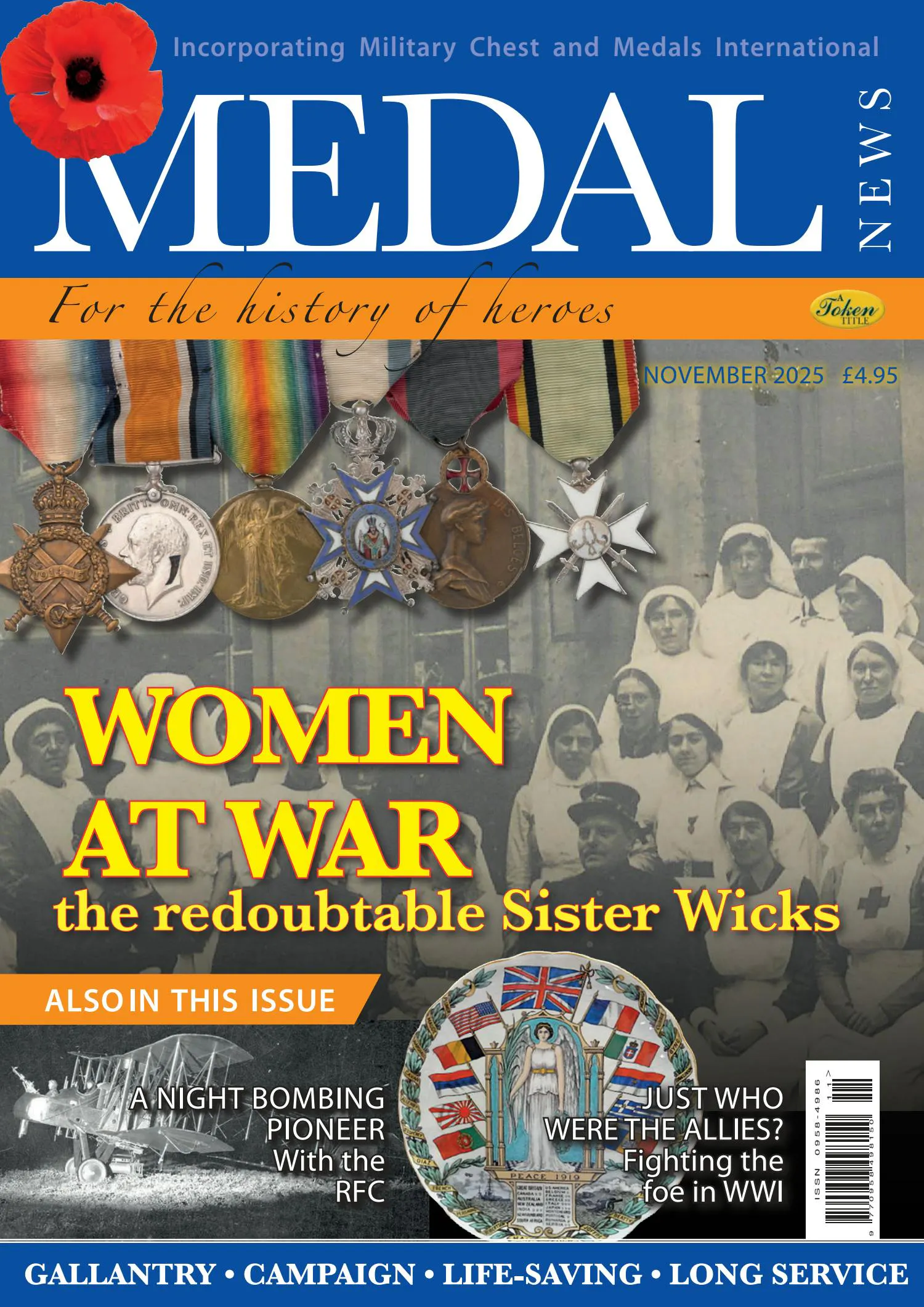
Women at War
Volume 63, Number 10, November 2025
Hi Ho Silver ANY collectors of World War I medals, indeed any collector who has ever been to a fair or perused a dealer’s website or auction house catalogue, will at some point have seen a Star and Victory Medal minus the corresponding British War Medal (BWM). A single BWM can exist as a sole entitlement, of course; a Star or Victory cannot, they always have to be accompanied by the corresponding silver disc, but they aren’t always. Why not? To understand why these broken groups exist, you have to go back to the late 1970s / early 80s and three brothers: Nelson Bunker Hunt, William Herbert Hunt and Lamar Hunt, who tried to corner the world silver market. They did this by simply buying up all the silver they could, both physically and in “futures” and, as a consequence, in one single year, from January 1979 to January 1980, the price of the metal went from $6.08 a troy ounce to $49.45 (£22.41 on the exchange rate at the time). An increase of over 700 per cent. Silver futures reached even higher. Needless to say that even though it is estimated they eventually owned over 100 million troy ounces of actual silver, the Hunt Brothers failed in their aim, and by the time the bubble burst they lost over $1 billion; but the damage was done—millions of silver items, from coins to cutlery, had been sold and melted down as the price of the metal crept ever upwards. And that, of course, included medals. Most British medals, from Victorian times up until the mid-20th century, were struck in silver and whilst the earlier ones were still worth more as collectables (although undoubtedly the more “ordinary” Crimeas, QSAs and the like also found their way into the pot), the humble British War Medal was suddenly worth more as a lump of silver than it was on the collector market. You have to remember that in the period we are talking, medals weren’t collected in the same way as they are today and few fetched big money; the BWM was particularly vulnerable, of course, as those happy to dispose of them reasoned they still had at least one medal to remember the recipient by. So it is that up and down the country, BWMs (which weigh 1oz) were taken into jewellers and pawn shops and simply melted down, sold for scrap and lost forever. What, you might ask, has that got to do with our hobby now? Surely, no medal collector out there would dream of scrapping medals, even a lowly BWM, no matter how high the silver price got. Well, one hopes not, but it may not have escaped your notice that silver is on the up again, it’s not scaling the heights (even relatively speaking) that gold is but, as of October 17, 2025, as I write this “Comment”, silver stands at $52.92 per troy ounce or £39.46. That means, once again, a British War Medal is, realistically, worth more as a piece of scrap metal than it is as a collectable. In other words, people paying nearly £40 for a BWM to a gunner in the artillery or a private in the Service Corps are more likely to be doing so for its scrap value than its value as a piece of history. I doubt very much that any collector will be scrapping their medals any time soon, I hope that should they need the money badly enough they will sell entire groups rather than hive off just one medal, but not all of those trading in medals think as we do and it is more than possible that if silver continues on the up then we will start to see medals described and valued by weight rather than by unit or recipient. Sadly there’s little we can do about that; those outside our hobby who buy and sell medals as commodities, just as they would any other antique or curio, cannot be blamed for not considering the bigger picture, cannot be sanctioned for splitting groups if it increases their profits, it is their livelihood after all. No, all we can do is keep our eyes open and try to do our best to explain why the whole is ultimately worth more than the sum of the parts even if it doesn’t immediately seem that way. So, if you do see a split group in a junk shop or at your local auction, perhaps have a word, try to tell the seller why keeping things together is more important than mere money. It won’t be easy, I grant you that, you may get nowhere, but at least you will have tried. People didn’t try that hard back in 1979, didn’t realise what they were losing; we do now, and we really must try to not see a repeat of what happened back then. There are enough broken groups as it is, we don’t need more.
Order Back Issue
You can order this item as a back issue, simply click the button below to add it to your shopping basket.