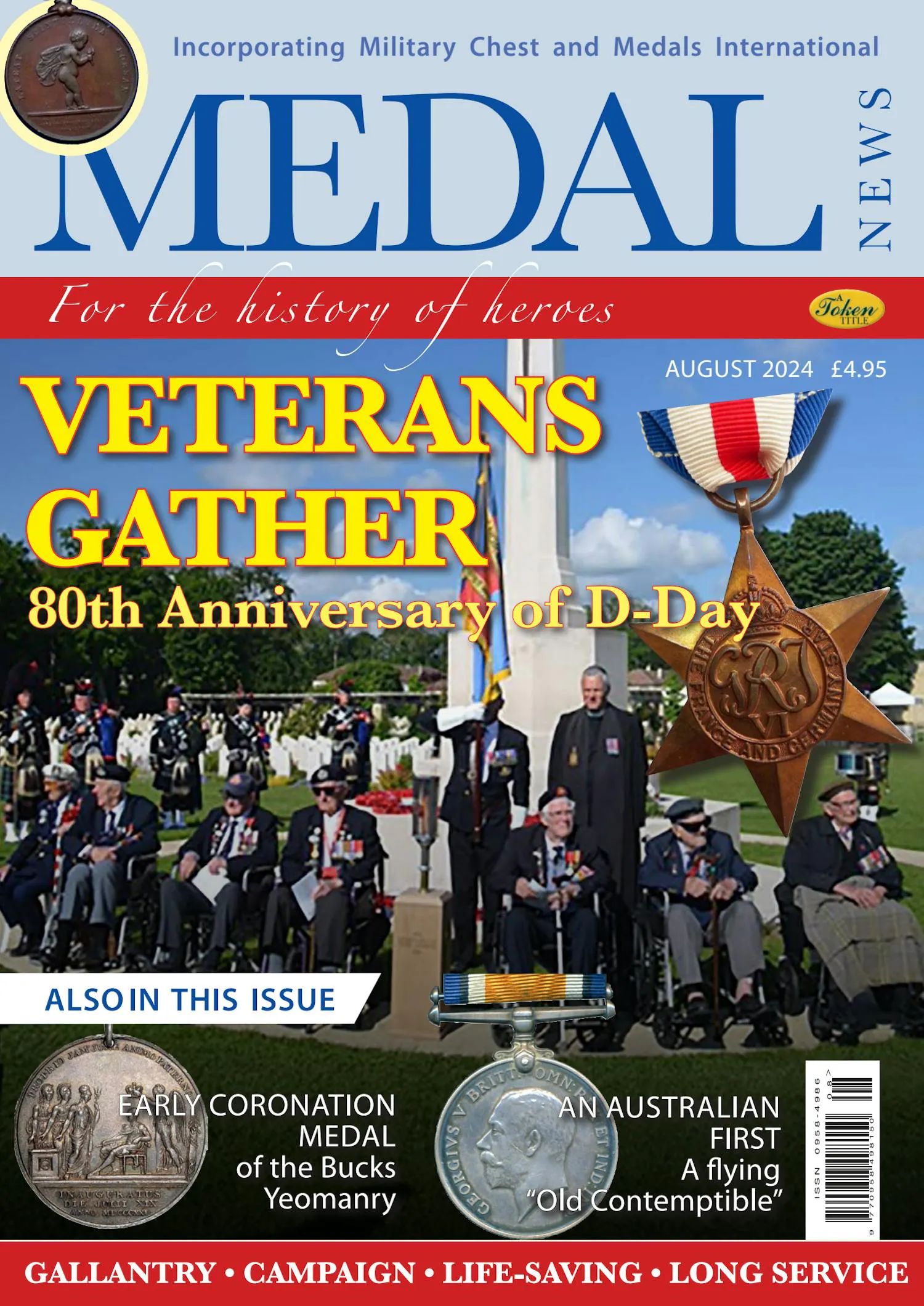
Veterans gather
Volume 62, Number 7, August 2024
Priceless WORLD War II medals are frequently overlooked by collectors. Unless there is a named medal in the group, they come with documentation (logbooks, diaries, photographs et al) or can be attributed in some other way to a specific recipient then the stars and medals awarded for 1939–45 are, in the main, not considered particularly “exciting” and won’t tend to change hands for much money. An original Air Crew Europe Star will, of course, still fetch £100s, collectors know that whoever once owned that medal will, at some point, have been in a plane over occupied Europe. The Pacific Star is fetching a little bit more than its fellows purely because there were fewer awarded and the Arctic Star is still a novelty, and because most remain with the recipient or the family, and thus are not coming on the open market, prices are still healthy. But for the 1939–45 Star, the Africa Star, the Italy Star, the Burma Star, the Atlantic Star, even the D-Day associated France and Germany Star, and, of course, the Defence Medal and War Medal, they aren’t considered rare or really that interesting, and whilst no medal is ever “looked down on” by collectors, unnamed World War II medals would rarely hold pride of place in a collection unless, perhaps, they were awarded to the relative of the collector in question. Partly this is down to the aforementioned attribution, of course it is, we aren’t coin collectors, we don’t simply collect pieces of metal but rather we seek out the men and the stories behind the medals, not just the objects themselves, and with an unnamed World War II group there is just no telling what that story is or who is behind it. A group comprising a France and Germany Star along with a 1939–45 Star and a War Medal could just as easily belong to a man who went onto the beaches with the first wave on D-Day as someone who landed in France in the early spring of 1945 and, for a collector, being able to tell the difference (or not being able to tell) is hugely important. The other reason World War II medals aren’t as eagerly sought after as others is the sheer number available, millions upon millions of these were produced, and as time has gone by more and more have found themselves on the open market. These two factors, the anonymity coupled with the quantity, has inevitably meant that interest in these medals isn’t great—until perhaps you actually see them being worn. Those who watched the D-Day commemorations back in June can’t have failed to see these innocuous medals on the chests of those who actually earned them, the frail men who turned the tide of war 80 years ago and who now slowly fade away before our eyes. Most were in wheelchairs, all were in their late 90s/early 100s but every single one of them wore his medals with immense pride. They had their 1939–45 Stars, France and Germany or Atlantic Stars and their War Medals, there were also Africa Stars, Italy Stars, Arctic Stars and most had the Legion d’Honneur too (an honour bestowed by the French on surviving Normandy veterans some ten years ago for the 70th anniversary of D-Day, as one veteran of my acquaintance said at the time, “it’s our reward for staying alive so long”). Some had other medals, unofficial ones they have acquired over the years, one or two had so many medals they seemed to be more bowed over by them than by age. Of course, for most of them the medals that they wore were unnamed, they could have been bought by any of us at any medal fair or auction for not too much money, but these weren’t medal fair purchases, they were medals that had actually been awarded, and to the men who wore them for maybe one last time at Arromanches and Bayeux this June, they were priceless. It is all too easy for us collectors to forget what these things we collect actually are, what they meant to those who were awarded them and whilst no, unnamed World War II medals are ever going to be as “exciting” as Zulu Medals, an MGS or a Crimea, we mustn’t ever lose sight of what they represent. Soon, in the not-too-distant future, there’ll be no one left wearing these medals, no one left who actually received them for their service. I hope, when that day comes, these “ordinary” medals won’t simply sit there ignored and unloved in albums, relegated only to pieces of metal and silk. I hope we at least will still remember exactly what they are, who they were given to and why. We owe the recipients that I think, even if we’ll never really know who they were.
Order Back Issue
You can order this item as a back issue, simply click the button below to add it to your shopping basket.